Building Production-Ready AI Engineering Capability in a GCC
USMICRO helped a Global Capability Center move beyond notebook-level AI experimentation by introducing capability-based technical assessment, stronger data and MLOps foundations, and production engineering practices for deploying, monitoring and integrating AI into real products.
What needed to change.
The GCC had successfully attracted engineers carrying AI-oriented titles, but the organization was not seeing an equivalent increase in production-ready AI capability.
Six months into the programme, teams could create promising models and prototypes in notebook environments, yet the GCC still lacked a reliable path for moving those models into production applications.
The gap became visible across several areas. Engineers could experiment with models but often lacked sufficient experience in production data pipelines, deployment patterns, version management, monitoring, retraining and rollback.
Responsible-AI and governance practices were also inconsistent, while model work was frequently disconnected from the product and application workflows in which the intelligence ultimately needed to operate.
Traditional resume screening reinforced the problem because AI-oriented job titles did not reliably indicate whether a candidate could engineer an end-to-end production system.
The challenge was therefore not simply hiring more AI engineers. It was defining, assessing and building the complete engineering capability required to turn AI investment into reliable production software.
How the problem was approached.
USMICRO introduced an AI engineering capability framework tailored to the GCC operating model.
Instead of evaluating talent primarily through job titles, keyword matching or isolated model-development exercises, the assessment framework examined the complete production AI lifecycle.
Engineers were evaluated across data foundations, pipeline architecture, model deployment, MLOps, monitoring, responsible-AI controls and integration with application and product workflows.
Technical assessments were designed to expose the difference between notebook-level experimentation and the ability to engineer reliable production systems.
USMICRO also helped structure capability development around the gaps identified through assessment, allowing the GCC to strengthen engineering practices rather than simply continue adding headcount.
The resulting model shifted talent decisions from AI-title-driven hiring toward evidence-based engineering capability, while giving the GCC a clearer technical standard for building and scaling AI teams.
What changed in the technology environment.
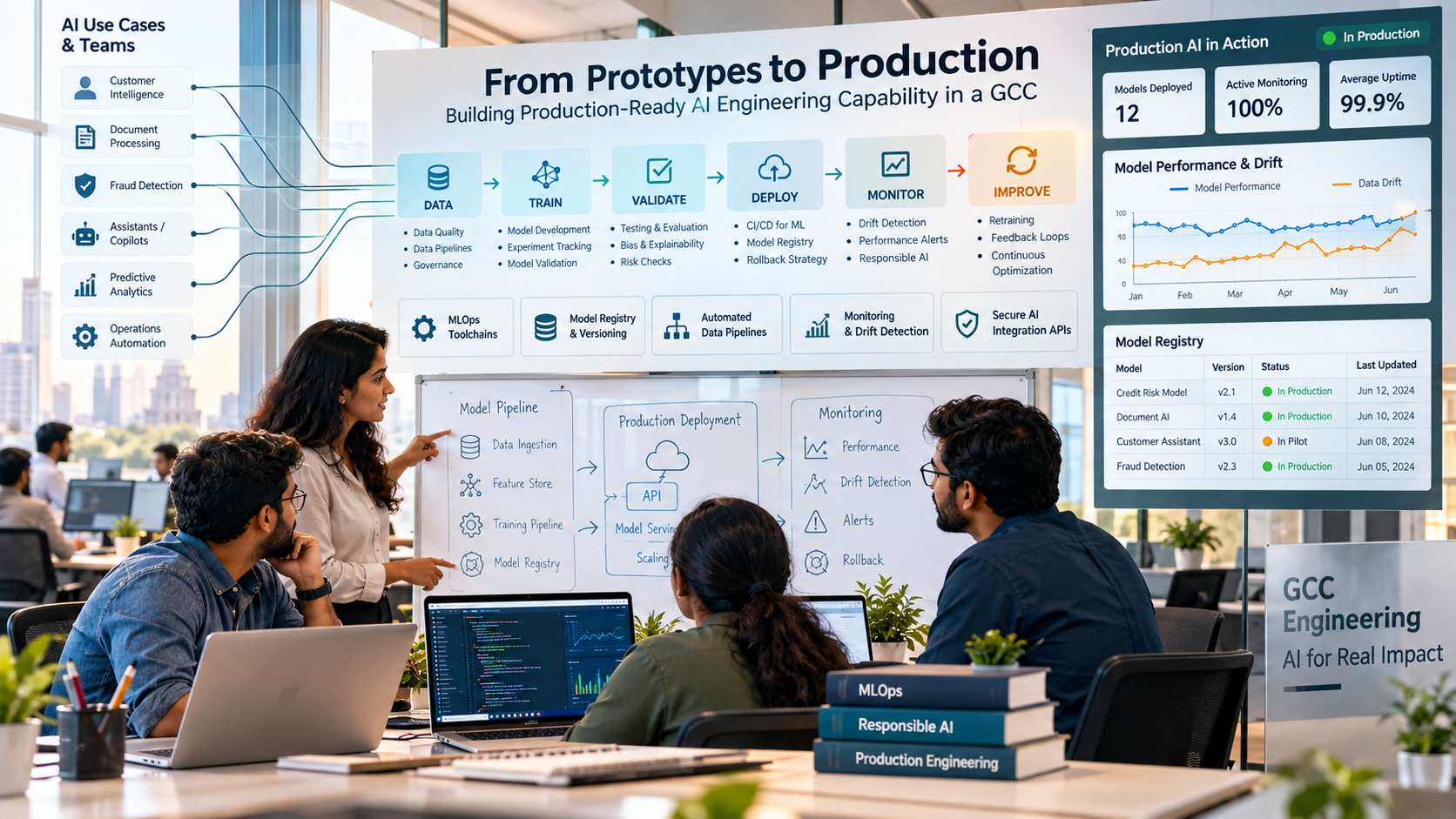
USMICRO introduced a production-oriented AI engineering model spanning data pipelines, model lifecycle management, monitoring, responsible-AI controls and application integration.
Data-quality and pipeline disciplines were strengthened so model inputs could be governed, validated and monitored as real-world data changed.
MLOps practices introduced model versioning, repeatable deployment workflows, continuous monitoring, automated retraining patterns and rollback mechanisms.
Model registries and version-management controls provided traceability across experimentation, validation and production deployment.
Monitoring and drift-detection frameworks were incorporated into the production lifecycle so changes in model behavior or data characteristics could be identified after deployment.
Responsible-AI practices — including bias testing, explainability and prompt governance where generative AI was involved — were incorporated into engineering workflows rather than added only at the end of the delivery process.
Secure model and prompt integration APIs connected AI capabilities with actual application and product workflows.
The technical shift was therefore from isolated notebook prototypes and model-centric experimentation toward governed data pipelines, production MLOps, continuous monitoring and product-integrated AI engineering.
What can be credibly demonstrated.
The capability programme materially changed how the GCC evaluated and developed AI engineering talent.
Engineering readiness was no longer defined primarily by the ability to create a model or prototype. Teams were assessed against the complete production lifecycle, including data foundations, deployment, observability, governance and product integration.
This helped the GCC establish stronger production disciplines around model versioning, monitoring, retraining and rollback while reducing dependence on notebook-only development patterns.
AI initiatives gained a more repeatable path from experimentation into production applications, with engineering controls embedded earlier in the lifecycle.
The resulting capability also improved alignment between AI specialists, software engineers, platform teams and product owners because model development became part of the wider engineering environment rather than an isolated technical activity.
Most importantly, the GCC established a more sustainable foundation for scaling AI capability through engineering standards, assessment discipline and repeatable production practices.