Modernizing Retail Commerce from Monolith to Composable Microservices
USMICRO established an ODC-led commerce modernization programme that decoupled digital experiences from the legacy backend, decomposed core commerce functions into independently deployable services and introduced API, event and DevOps foundations for faster, lower-risk change.
What needed to change.
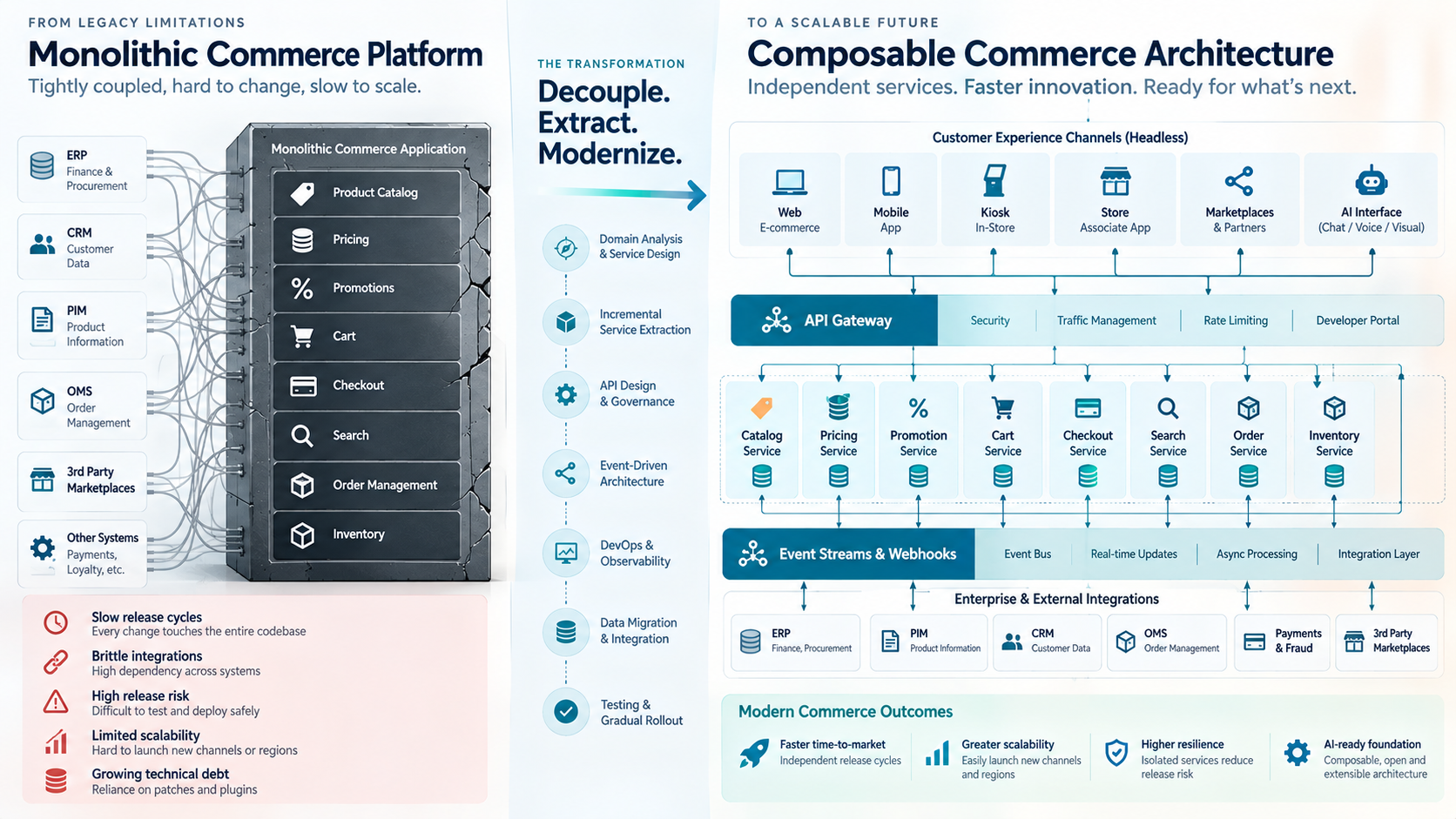
The retailer’s commerce platform had evolved as a tightly coupled monolithic system in which customer experiences, commerce logic and enterprise integrations were deeply interdependent.
Changes to product, pricing, promotions, cart, checkout or order-management functionality often touched the same codebase and release process, making even targeted updates harder to isolate and test.
Integrations with ERP, OMS, CRM, PIM and fulfillment platforms had also accumulated over time, creating brittle dependencies and increasing release risk whenever one part of the environment changed.
The architecture limited the retailer’s ability to introduce new customer channels, regional variations, personalization services or emerging AI-assisted experiences without additional customization and duplicated development.
As technical debt increased, business teams became increasingly dependent on temporary patches, plugins and workarounds that made the platform even harder to evolve.
The challenge was therefore not simply to replace a monolith with microservices. It was to create a commerce architecture in which experiences, business capabilities and enterprise integrations could change independently without losing operational control.
How the problem was approached.
USMICRO established a dedicated Offshore Development Center comprising senior platform architects, microservices engineers, integration specialists and DevOps capability.
The modernization programme began by identifying the major commerce domains embedded within the monolith and defining clear ownership and service boundaries around functions such as catalog, pricing, promotions, cart, checkout, inventory, search and order management.
The customer-facing experience layer was separated from backend commerce services so web, mobile, kiosk, in-store and future digital interfaces could evolve without requiring equivalent changes to the underlying commerce platform.
Offshore engineering squads progressively extracted business capabilities into independently deployable services rather than attempting a high-risk single-stage platform replacement.
API standards, event patterns, service ownership, deployment practices and observability requirements were governed through the ODC model to reduce the risk of replacing one monolith with an uncontrolled collection of tightly coupled services.
The programme therefore combined architecture modernization with the engineering and operational disciplines required to sustain a composable commerce environment over time.
What changed in the technology environment.
USMICRO introduced a headless and composable commerce architecture separating customer experience channels from independently deployable commerce services.
Web, mobile, kiosk, in-store tablet and emerging interface layers accessed commerce capabilities through governed APIs rather than relying directly on a shared monolithic backend.
Core domains including product catalog, pricing, promotions, cart, checkout, order management, inventory and search were decomposed into purpose-built services with independent ownership and deployment boundaries.
API gateways provided governed access to commerce capabilities, while event streams and webhooks supported asynchronous communication between services and downstream enterprise systems.
ERP, PIM, CRM, OMS and fulfillment environments were connected through reusable integration services rather than channel-specific point-to-point dependencies.
Cloud DevOps pipelines enabled services to be built, tested and released independently, while observability standards provided visibility into service health, dependencies and runtime behavior.
The architectural shift was therefore from a tightly coupled monolithic commerce platform with shared release risk toward headless experiences, domain-aligned services, API-first integration, event-driven communication and independently deployable commerce capabilities.
What can be credibly demonstrated.
The new architecture materially changed how the retailer could evolve its commerce environment.
Separating customer-facing experiences from backend commerce services allowed digital channels to change without requiring the entire platform to move through the same release cycle.
Domain-aligned services gave engineering teams clearer ownership and made functional changes easier to isolate, test and deploy.
Independent deployment pipelines reduced dependence on coordinated monolithic releases and created a more flexible path for introducing new commerce capabilities.
API and event-driven integration patterns also provided a cleaner way to connect enterprise systems, marketplaces and new experience layers without continuously adding direct dependencies to the core platform.
The architecture established a stronger foundation for regional expansion, personalization and future AI-assisted commerce experiences because channels and business capabilities could evolve more independently.
Most importantly, the retailer moved from a platform optimized around protecting a fragile codebase toward an architecture designed for controlled, continuous change.