Security reviews often happen at the point where software is almost ready to move.
The application has been built. The pipeline exists. Infrastructure has been provisioned. Dependencies have been selected. The release date is approaching.
Then security enters the conversation.
A vulnerability scan finds an issue. An access pattern needs to change. A dependency is no longer acceptable. Logging is insufficient. Secrets have been handled incorrectly. A deployment configuration violates policy.
At that point, security becomes expensive.
Not necessarily because the control itself is difficult, but because the system has already been designed around assumptions that now need to be revisited.
This is why secure software delivery works better when security is part of the engineering system rather than a gate positioned at the end of it.
A release gate can detect risk. It cannot redesign the delivery system.
Final security reviews have a legitimate role.
Some systems require formal approval. Certain changes warrant specialist assessment. High-risk applications may need additional controls before production.
The problem begins when the release gate becomes the primary mechanism through which security is introduced.
By then, many important decisions have already been made:
- how identities are represented;
- where authorization decisions occur;
- how secrets are stored;
- which third-party components are used;
- how infrastructure is configured;
- what information is logged;
- how services communicate;
- how data is protected; and
- how software moves from source code to production.
A late review can identify weaknesses in those decisions.
It cannot make them inexpensive to change.
Security becomes scalable when controls become reusable engineering capabilities.
Security teams cannot manually inspect every engineering decision in a growing technology environment.
Development teams cannot repeatedly interpret hundreds of controls from first principles either.
The scalable answer is to move appropriate security knowledge into reusable technology.
That can include:
- approved application templates;
- secure infrastructure modules;
- standard identity integrations;
- central secrets-management patterns;
- pipeline security checks;
- dependency scanning;
- container-image controls;
- policy-as-code;
- default logging and telemetry; and
- supported deployment patterns.
This is where Cybersecurity becomes closely connected to platform engineering and software delivery.
The strongest controls are often the ones developers receive automatically because they are embedded into the path used to build and deploy software.
Secure defaults are more powerful than repeated instructions.
Documentation matters.
Training matters.
Standards matter.
But every control that depends entirely on somebody remembering a document creates another opportunity for inconsistency.
A secure default changes the equation.
If a newly created service automatically receives an approved base image, standard identity integration, secrets-management configuration, baseline telemetry and mandatory pipeline checks, the organization has reduced the number of security decisions each application team must independently reproduce.
This does not remove accountability from developers.
It gives them a safer starting point.
The principle is simple:
Make the secure path easier to follow than the insecure one.
Identity should be an architectural concern, not an application afterthought.
Many security problems ultimately become questions of identity.
Who is making the request?
What are they allowed to access?
Which service is calling another service?
Which workload is permitted to retrieve a secret, update a record or invoke an external system?
If these decisions are handled differently by every application, security complexity grows rapidly.
A mature delivery environment therefore establishes consistent identity and access patterns across applications, infrastructure and automation.
That can include:
- centralized identity providers;
- role- or attribute-based authorization;
- workload identities;
- short-lived credentials;
- least-privilege service accounts;
- managed secrets;
- segregated deployment permissions; and
- auditable privileged access.
The objective is not merely stronger authentication.
It is clearer trust boundaries throughout the system.
The software supply chain is part of the attack surface.
Modern software is assembled from far more than internally written source code.
Applications depend on open-source libraries, package repositories, container images, build tools, CI/CD services, infrastructure definitions and third-party services.
That expands the security boundary.
Teams need visibility into questions such as:
- Which dependencies are entering the build?
- Are known vulnerabilities present?
- Where did a container image originate?
- Who can change the pipeline?
- Which credentials are available during build and deployment?
- Can generated artifacts be traced back to their source?
- Are critical dependencies being updated?
- Can unauthorized changes enter the release process?
These controls belong inside the delivery workflow because the supply chain itself is part of the software system.
Automation changes security from periodic inspection to continuous feedback.
A security review performed once before release produces a snapshot.
Software changes continuously.
Dependencies are updated. Infrastructure changes. New code is merged. Configuration evolves. Deployment environments change.
Automation allows relevant controls to run repeatedly as part of normal engineering activity.
Depending on the application and risk profile, pipelines may incorporate:
- static application security testing;
- dependency and software-composition analysis;
- secret detection;
- container-image scanning;
- infrastructure-as-code checks;
- license-policy validation;
- API testing;
- configuration validation; and
- deployment-policy enforcement.
Not every finding should automatically block every release.
That approach can create alert fatigue and encourage teams to work around the control system.
The better model is risk-aware automation: clear severity thresholds, meaningful exceptions, traceable decisions and controls proportionate to the system being protected.
Security signals need context.
A scanner can produce thousands of findings.
That does not mean every finding represents the same risk.
Useful prioritization depends on context.
- Is the vulnerable component reachable?
- Is the application exposed externally?
- What data does the system handle?
- Does an exploit path actually exist?
- What privileges are available?
- Is compensating control already present?
- How critical is the business service?
Without context, security automation risks becoming another source of noise.
With context, it becomes an engineering decision-support system.
This is one reason security tooling should integrate with the wider Cloud & DevOps environment rather than operate as an isolated reporting layer.
Production security depends on observability.
Preventive controls are important.
They are not sufficient.
No engineering organization should assume every undesirable condition will be prevented before software reaches production.
The operating environment therefore needs the ability to detect behaviour that matters.
That may include visibility into:
- authentication failures;
- privilege changes;
- unexpected network activity;
- unusual API usage;
- configuration drift;
- anomalous workload behaviour;
- changes to sensitive resources;
- software and infrastructure events; and
- security-relevant application telemetry.
Security observability becomes much stronger when applications and platforms produce the necessary telemetry by design.
Retrofitting visibility after an incident is too late.
Security ownership has to be distributed without becoming ambiguous.
“Security is everyone’s responsibility” is directionally useful.
Operationally, it can also become vague.
Shared responsibility works only when specific responsibilities remain clear.
For example:
- Application teams own secure implementation and appropriate use of platform capabilities.
- Platform teams can provide reusable secure defaults and delivery controls.
- Security teams define risk frameworks, specialist controls, threat guidance and assurance.
- Infrastructure teams maintain secure foundations and environment controls.
- Business owners remain accountable for the risk associated with the systems they depend on.
The goal is not to centralize every decision in security.
It is to distribute security capability without losing accountability.
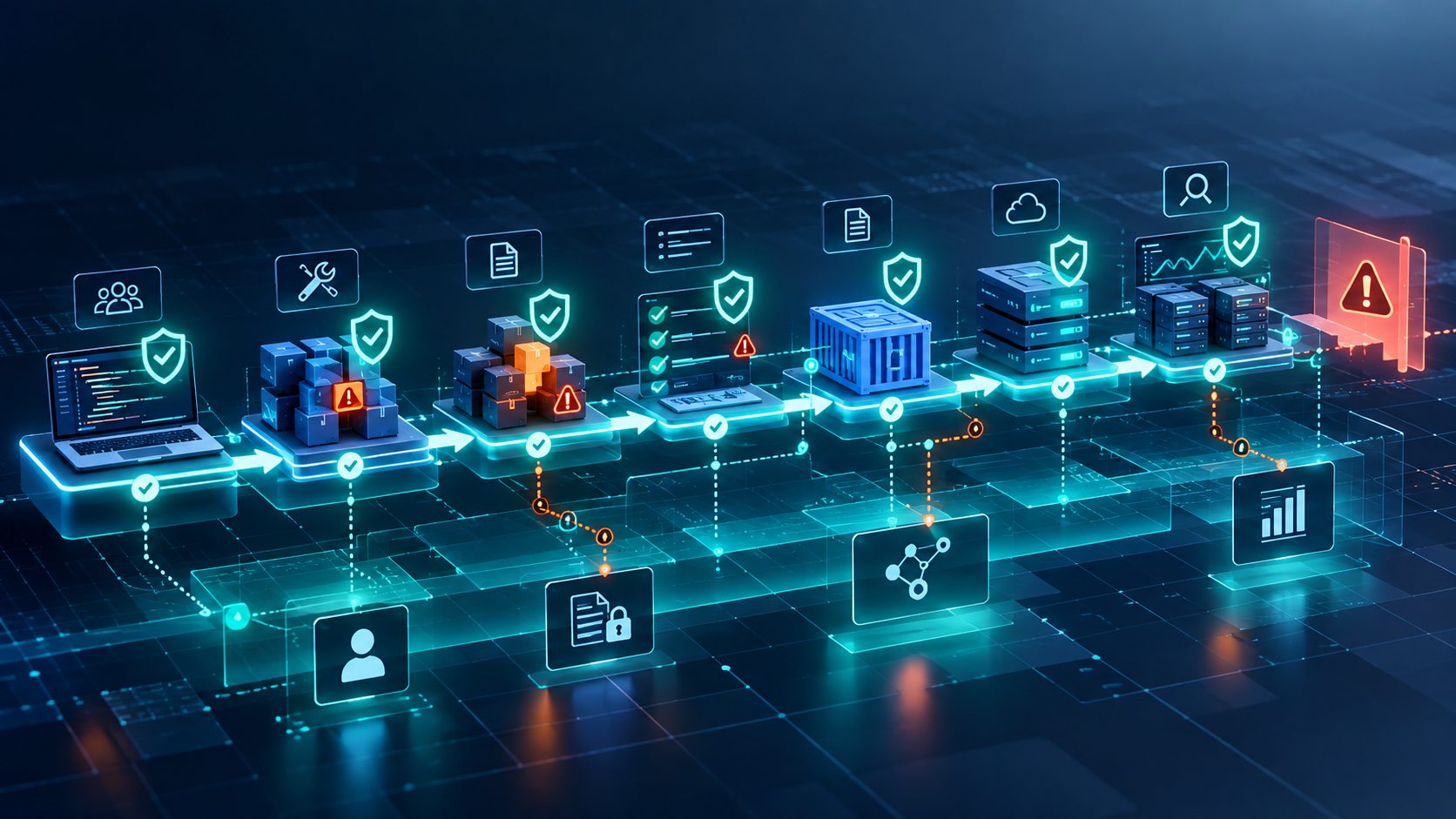
A practical secure-delivery progression.
Organizations do not need to automate every security control at once.
A useful progression starts with the controls that recur most frequently across delivery.
01 — Define the important trust boundaries.
Understand users, workloads, systems, data and external integrations before choosing controls.
02 — Establish secure engineering defaults.
Create reusable patterns for identity, secrets, infrastructure, logging and common application foundations.
03 — Move repeatable checks into the pipeline.
Automate appropriate code, dependency, infrastructure and configuration controls where feedback can reach developers early.
04 — Protect the delivery system itself.
Secure repositories, build systems, artifacts, credentials and deployment permissions.
05 — Make exceptions explicit and traceable.
Not every risk can be eliminated immediately. Exceptions should have ownership, rationale and appropriate review rather than becoming invisible workarounds.
06 — Design production visibility.
Ensure applications and platforms generate security-relevant telemetry and that meaningful signals can reach the teams responsible for response.
07 — Improve controls from operational evidence.
Incidents, recurring findings and developer friction should feed changes to templates, pipelines, policies and platform capabilities.
The goal is not more security gates. It is a more secure engineering system.
Security teams will always need specialist expertise.
Some systems will always require formal reviews.
Some risks will always demand human judgment.
But those realities should not force security to remain separate from software engineering.
The more frequently a security requirement appears, the stronger the case for turning it into reusable engineering capability.
That may mean a platform default, an automated pipeline control, a standard identity pattern, infrastructure policy, observability capability or secure service template.
Each one moves security earlier without requiring developers to become security specialists.
And each one reduces the likelihood that the first meaningful security conversation happens just before release.
The most effective security programme is not the one that creates the most gates. It is the one that makes secure engineering increasingly normal.
That is why security belongs inside the delivery system — alongside architecture, automation, quality and Product & Platform Engineering — rather than waiting at the release gate.