Many AI initiatives begin under unusually favourable conditions.
The use case is narrow. The dataset is carefully selected. A small team is deeply involved. Exceptions are handled manually. Costs are tolerable because usage is limited. And when something breaks, the people who built the pilot are usually close enough to fix it.
That environment is useful for answering an important question:
Can this idea work?
But production asks a much harder question:
Can this capability keep working when it becomes part of the business?
That distinction is where many promising AI initiatives begin to struggle.
A successful pilot can demonstrate technical feasibility. It does not automatically establish the architecture, data discipline, operating ownership, governance, economics or reliability required for sustained use.
The transition from experiment to operating capability is therefore not primarily a model-development problem.
It is a systems-engineering problem.
A pilot proves possibility. Production proves operability.
During a pilot, success is often defined by whether the model can produce a useful result.
That is a reasonable starting point.
But once the solution moves into production, the definition of success changes.
The organization now needs to know whether the system can:
- perform consistently across real-world inputs;
- integrate with existing applications and workflows;
- operate within acceptable latency and availability thresholds;
- identify when confidence is low;
- handle failures without disrupting critical processes;
- maintain appropriate security and access controls;
- detect changes in data or behaviour;
- support auditability where decisions matter;
- operate at a commercially sensible cost; and
- remain maintainable after the original project team moves on.
These are not peripheral engineering concerns.
They are part of the AI capability itself.
A model that performs well in isolation but cannot operate reliably inside the surrounding technology estate has not yet become a production capability.
The model is only one component of the system.
AI conversations naturally focus on models.
Which model should be used? How accurate is it? Should the organization build, fine-tune or consume a managed service? Which foundation model performs best for the task?
Those questions matter.
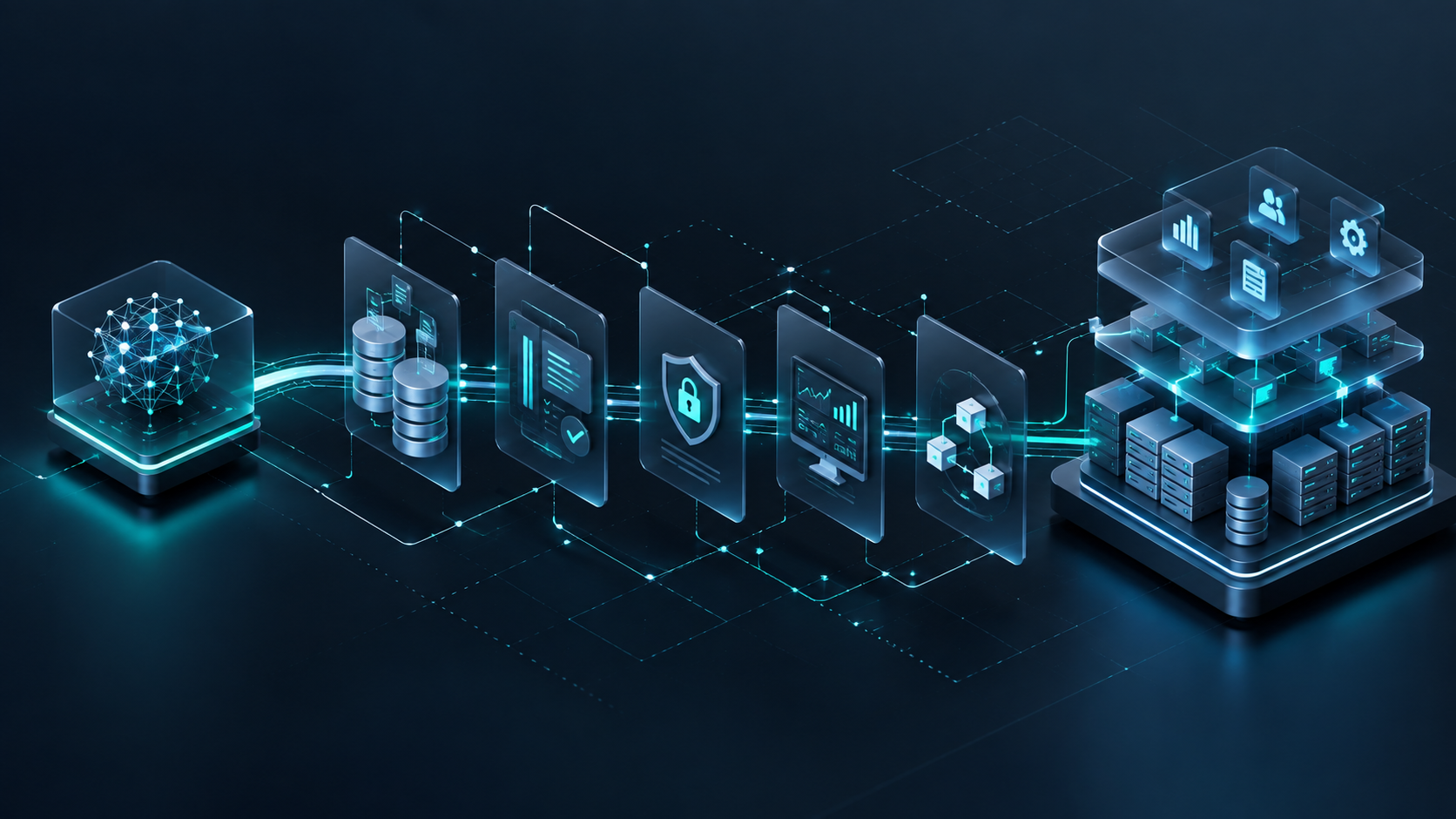
But production systems contain far more than the model.
- Data acquisition and preparation. What information enters the system, where it comes from and whether it is sufficiently current and trustworthy.
- Retrieval or contextualization. How enterprise information is identified and supplied to the model.
- Application logic. The rules controlling when AI is invoked, how outputs are interpreted and what happens next.
- Identity and authorization. Which users or services can access which information and actions.
- Evaluation. How the organization determines whether the output remains acceptable.
- Observability. How teams detect degradation, failures, abnormal behaviour and cost anomalies.
- Fallback behaviour. What happens when the model cannot respond reliably.
- Human intervention. Where review, approval or escalation remains necessary.
- Integration. How the capability interacts with operational systems, APIs, workflows and user experiences.
The AI model may be the most visible component.
But it is rarely the entire product.
For engineering teams, this changes the architectural question from “Which model should we use?” to “What system do we need around the model so that the capability can be trusted?”
That is a substantially broader problem — and one that connects AI directly to disciplines such as Product & Platform Engineering.
Data stops being an input and becomes infrastructure.
Pilots can survive imperfect data surprisingly well.
Teams can manually clean a file. Select a reliable sample. Correct an inconsistent field. Re-run an extraction. Explain an unusual result.
Production does not have that luxury.
Once AI enters an operational workflow, data quality becomes part of service reliability.
Teams need clarity around questions such as:
- Which systems are authoritative?
- How fresh must the data be?
- What happens when an upstream source is unavailable?
- Who owns schema changes?
- How are permissions propagated?
- How is sensitive information excluded or masked?
- Can the system distinguish obsolete information from current information?
- How are retrieval quality and provenance monitored?
For generative AI in particular, weak data foundations can produce a dangerous illusion.
The model may be functioning perfectly while the system is supplying incomplete, outdated or inappropriate context.
The result can still look fluent.
That makes data engineering, metadata, lineage, access management and retrieval design central to the quality of the AI solution.
In mature production environments, the question is no longer merely whether the model can reason over information. It is whether the organization can reliably supply the right information, at the right time, under the right controls.
This is where AI & Data Engineering becomes inseparable from the AI application itself.
Evaluation has to survive the real world.
A demonstration dataset is finite.
Production behaviour is not.
Users phrase the same request differently. Business conditions change. Product data evolves. Policies are revised. New edge cases appear. Models themselves may change underneath managed services.
This means evaluation cannot be a one-time exercise performed before launch.
It has to become part of the operating system.
Depending on the use case, production evaluation may include:
- factual correctness;
- relevance;
- completeness;
- groundedness;
- adherence to business rules;
- safety;
- latency;
- consistency;
- user acceptance;
- escalation frequency;
- task completion rate; and
- the quality of downstream business outcomes.
Some evaluation can be automated. Some requires human review.
The important shift is that teams stop asking only “Did the model pass our test?” and begin asking:
How will we know, continuously, whether the capability is still behaving acceptably?
That is an operational question.
Governance cannot arrive after deployment.
Governance is sometimes treated as a later-stage concern — something to formalize once the technology proves valuable.
That sequence creates avoidable problems.
Once an AI system begins influencing customer interactions, employee decisions, financial processes, operational workflows or regulated information, governance becomes inseparable from design.
Teams need to understand early:
- what data the system is permitted to use;
- which decisions AI may influence;
- where human approval is mandatory;
- how outputs can be challenged;
- what events must be logged;
- who owns the risk;
- how model or prompt changes are controlled; and
- what happens when the system behaves outside expected boundaries.
Good governance does not have to slow engineering.
Done well, it gives engineering teams clearer operating constraints.
The problem arises when those constraints are discovered only after the pilot has already shaped the architecture.
Retrofitting control is usually harder than designing for it. The same principle applies to Cybersecurity: security becomes much more effective when it is part of the system architecture rather than an approval activity at the end.
Operating ownership matters as much as model accuracy.
A pilot often has obvious ownership.
The innovation team owns it. The data science team owns it. The transformation team owns it.
Production creates a more difficult question:
Who owns it when the experiment is over?
If an AI capability becomes part of a business process, somebody must own its continued operation.
- Engineering ownership. Who maintains the services, integrations and deployment pipeline?
- Data ownership. Who is accountable for the underlying information?
- Model ownership. Who monitors model behaviour and manages changes?
- Security ownership. Who reviews access, vulnerabilities and emerging risks?
- Business ownership. Who decides whether the capability continues to deliver enough value?
- Operational ownership. Who responds when the service fails at 10:00 on a Monday morning?
A system with no clear answer to these questions is unlikely to mature cleanly.
Production AI is not simply deployed.
It is operated.
Cost changes the architecture.
Pilots are often too small for economics to dominate the design.
Production is different.
Inference calls multiply. Retrieval infrastructure grows. Observability generates data. GPUs or managed AI services create variable spend. Larger contexts increase token consumption. More users create concurrency requirements. Human-review processes add operating cost.
A technically excellent design may become commercially poor at scale.
That makes cost an architectural variable.
Teams may need to decide:
- whether every task requires the most capable model;
- whether smaller models can handle simpler workloads;
- which responses should be cached;
- how much context should be retrieved;
- when batch processing is appropriate;
- whether some workflows should remain deterministic;
- how frequently expensive evaluations should run; and
- what usage patterns warrant rate limits or controls.
AI architecture therefore needs to optimize not just for accuracy.
It needs to optimize for value per unit of operational cost.
That also makes disciplines such as Cloud & DevOps, observability and infrastructure engineering part of the AI operating model.
The path from AI experiment to operating capability.
There is no single production blueprint for every AI initiative.
But the transition becomes much more manageable when teams deliberately address the surrounding system.
01 — Define the workflow before optimizing the model.
Start with the operational problem. What decision, task or workflow is being improved? Who uses the output? What happens after the model responds?
A clear workflow prevents teams from optimizing technical metrics that have little connection to business value.
02 — Establish production data contracts.
Define the sources, freshness expectations, ownership, access rules and failure behaviour of critical data.
Data should not remain an informal dependency.
03 — Design evaluation before scale.
Agree what acceptable behaviour means before usage expands. Create representative test sets, quality measures and review mechanisms.
04 — Engineer observability and fallback.
Monitor more than infrastructure availability. Where appropriate, observe model quality, latency, retrieval effectiveness, failure patterns, cost and escalation behaviour.
And define what the system does when confidence is insufficient.
05 — Build security and governance into the architecture.
Control access, protect sensitive information, maintain appropriate logs and define where human oversight is required.
These should be system properties, not launch-checklist items.
06 — Assign operational ownership.
Make clear who operates the capability after deployment.
Production AI needs an owner, not just a project team.
07 — Measure economics in production.
Track whether the capability continues to justify the resources it consumes.
Model quality matters. So does the cost of delivering that quality at scale.
The real transition is organizational as well as technical.
Organizations sometimes frame the AI journey as a progression in model sophistication.
Prototype. Fine-tuning. Deployment. Scale.
But the more meaningful progression is often different:
Experiment → Product → Operating capability
Each stage asks a different question.
An experiment asks whether something is possible.
A product asks whether users can derive value from it.
An operating capability asks whether the organization can depend on it.
That final transition requires engineering discipline beyond the model itself.
Architecture has to accommodate uncertainty. Data needs ownership. Evaluation needs continuity. Security and governance must become design constraints. Operations need clear accountability. Economics have to remain sustainable.
The companies that move beyond perpetual AI experimentation will not necessarily be those with access to the most sophisticated model.
They will be the ones that learn how to build the systems, controls and operating practices around AI that make it dependable enough to become part of how the business actually works.