Technology modernization is often described as a migration programme.
Move applications to the cloud. Replace an aging platform. Rehost workloads. Rewrite services. Break apart a monolith. Introduce containers. Modernize the database.
Each of those activities can be useful.
But none of them, by itself, guarantees modernization.
A system can move from one infrastructure environment to another and preserve nearly every constraint that made it difficult to change in the first place.
The runtime may be newer.
The architecture may not be.
This is where modernization programmes begin to disappoint: architecture is treated as a technical detail of migration rather than the mechanism through which the system becomes more adaptable.
The distinction matters because the objective of modernization should not merely be to relocate software.
It should be to improve the organization’s ability to change it.
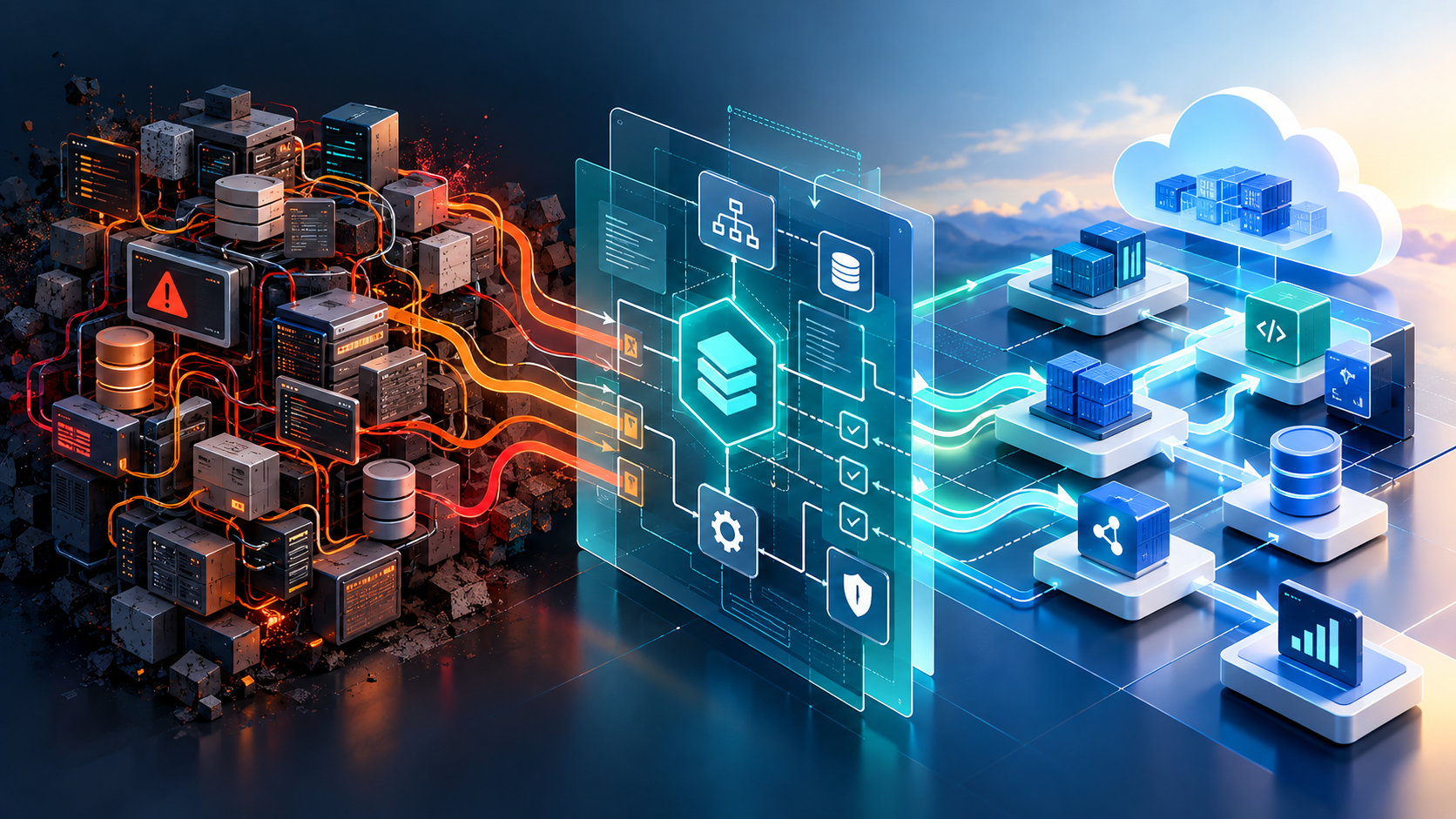
Migration changes location. Modernization changes constraints.
A migration programme asks:
- Where will the workload run?
- How will data be moved?
- Which infrastructure will replace the old environment?
- How will cutover be managed?
- How quickly can the transition be completed?
A modernization programme has to ask additional questions:
- Which dependencies make the system difficult to change?
- Where are business rules tightly coupled to technology?
- Which interfaces prevent independent delivery?
- Where does shared data create hidden coordination?
- Which components should remain stable and which need redesign?
- What architectural boundaries would make future change safer?
- How should the operating model evolve with the technology?
The second set of questions is harder.
It also determines whether modernization produces lasting value.
If those constraints remain untouched, the programme may produce a newer hosting model wrapped around essentially the same system behaviour.
The architecture that exists on paper is rarely the whole architecture.
Legacy systems are often more interconnected than their formal diagrams suggest.
A business-critical application may depend on:
- shared database tables;
- batch jobs;
- file transfers;
- scheduled scripts;
- manual operational procedures;
- point-to-point integrations;
- downstream reporting extracts;
- authentication assumptions;
- infrastructure conventions; and
- undocumented business rules accumulated over years.
Those relationships form the real architecture.
Modernization therefore begins with understanding the system as it actually behaves, not simply the application inventory that appears in programme documentation.
This is especially important in complex enterprise environments where one apparently small change can cross application, data, integration and operational boundaries.
A modernization plan built without that dependency picture is likely to underestimate both risk and sequencing.
A newer platform does not automatically create a better architecture.
Cloud platforms, containers, managed databases and modern frameworks provide powerful capabilities.
But technology choice cannot compensate for poor system boundaries.
A tightly coupled application deployed onto modern infrastructure is still tightly coupled.
A badly designed service decomposition can create more operational complexity than the monolith it replaced.
A collection of APIs does not automatically create a coherent platform.
A containerized workload is not necessarily a cloud-native system.
This is why modernization has to connect infrastructure decisions to Product & Platform Engineering and architecture decisions.
The critical question is not merely:
What technology should replace the old technology?
It is:
What should become easier, safer or more independent after the modernization?
Dependencies determine modernization difficulty.
Most modernization complexity comes from dependencies.
Some are obvious.
Others become visible only when teams attempt to change something.
A useful modernization assessment therefore examines several dependency types.
Application dependencies
Which components call, share or assume behaviour from others?
Data dependencies
Which systems read or write the same data, and where does shared ownership prevent independent change?
Integration dependencies
Which interfaces, queues, files or APIs connect the system to the wider technology estate?
Operational dependencies
Which monitoring, support, scheduling, release and recovery processes depend on the current design?
Organizational dependencies
Which teams need to coordinate every time one part of the system changes?
The objective is not to eliminate every dependency.
That would be unrealistic.
The objective is to identify which dependencies create disproportionate delivery friction or operational risk, and then deliberately redesign them.
Modernization should create boundaries that make change safer.
Good architecture creates boundaries.
Those boundaries allow parts of a system to evolve without requiring the entire estate to move at the same time.
Depending on the context, useful boundaries may be created around:
- business domains;
- application services;
- data ownership;
- integration contracts;
- deployment units;
- operational responsibilities; and
- security or trust boundaries.
The exact architectural style matters less than the underlying objective.
Can this part of the system change with less coordination, less risk and clearer ownership than before?
If the answer is no, the modernization may have changed implementation without improving adaptability.
Modernization does not require turning everything into microservices.
One of the easiest modernization mistakes is to replace one architectural fashion with another.
For some systems, service decomposition creates genuine value.
For others, a well-structured modular application may be simpler, cheaper and easier to operate.
Microservices introduce their own costs:
- network complexity;
- distributed failure modes;
- service discovery;
- observability requirements;
- deployment coordination;
- data consistency challenges;
- operational overhead; and
- greater platform-engineering demands.
The architecture should therefore follow the problem.
Modernization is not achieved by maximizing the number of services.
It is achieved by creating appropriate boundaries and reducing unnecessary coupling.
Data architecture often determines how far modernization can go.
Application architecture is frequently easier to change than data architecture.
Multiple applications may depend on the same database structures. Business rules may be embedded in stored procedures. Reporting systems may depend on undocumented schemas. Batch processes may assume specific tables or file formats.
This means application decomposition without data ownership can create an illusion of independence.
Services may look separate while remaining tightly coupled through shared data.
Modernization programmes therefore need to ask:
- Who owns each important data domain?
- Which systems are authoritative?
- Where is shared write access creating coupling?
- Which interfaces should replace direct database dependencies?
- How should historical data be migrated?
- Which reporting dependencies need to be preserved or redesigned?
The answers can materially change modernization sequencing.
Integration architecture is where old and new worlds meet.
Most enterprises cannot modernize an entire estate at once.
For a significant period, modernized components must coexist with legacy systems.
That makes integration architecture one of the most important parts of the transition.
APIs, events, messaging, adapters and anti-corruption layers can create controlled boundaries between old and new systems.
Used well, these patterns allow the organization to modernize progressively rather than attempting a high-risk, all-at-once replacement.
But integration should not simply reproduce every legacy dependency in a new technical form.
The transition architecture should actively reduce coupling where practical.
Cloud migration can expose architecture problems rather than solve them.
Moving workloads to cloud infrastructure can improve scalability, automation and access to managed services.
It can also make inefficient architecture more expensive or more visible.
A system designed around static infrastructure assumptions may not benefit from elasticity.
Chatty application dependencies may create latency problems.
Uncontrolled storage or compute patterns may increase cost.
Weak observability may become harder to tolerate in distributed environments.
This is why Cloud & DevOps modernization works best when infrastructure changes and architecture decisions are designed together.
The cloud should enable a better operating model.
It should not simply become a more modern place to host old assumptions.
Modernization sequencing is an architecture decision.
Large systems rarely have one obvious starting point.
Sequencing therefore matters.
A strong modernization roadmap considers:
- business value;
- dependency concentration;
- operational risk;
- technical obsolescence;
- team readiness;
- data dependencies;
- integration complexity;
- security exposure; and
- the ability of each step to enable the next.
Sometimes the best first modernization candidate is not the oldest system.
It may be the component whose redesign removes constraints from several other systems.
This is where dependency-aware architecture produces a better roadmap than a simple technology-age inventory.
Architecture decisions need explicit trade-offs.
Modernization creates many attractive options.
Rehost. Replatform. Refactor. Rewrite. Replace. Retire.
The right answer is often different for different parts of the estate.
What matters is that each choice is connected to a clear problem.
For example:
- Rehost when infrastructure is the primary constraint and application change adds little value.
- Replatform when managed services or automation can improve operations without major redesign.
- Refactor when architecture is preventing delivery, scalability or resilience.
- Replace when maintaining the existing capability no longer makes economic or strategic sense.
- Retire when the capability itself is no longer required.
Modernization should not become an ideological commitment to one technique.
It should be a portfolio of deliberate architectural decisions.
Security and resilience should improve with the architecture.
Modernization creates an opportunity to remove long-standing operational and security weaknesses.
That opportunity is lost if security is treated only as a control to be reimplemented after migration.
Architecture decisions can improve:
- identity boundaries;
- least-privilege access;
- secret management;
- network segmentation;
- logging and observability;
- recovery patterns;
- software supply-chain controls; and
- isolation between critical components.
This is where modernization and Cybersecurity should reinforce each other.
A newer system that preserves the same trust assumptions and control weaknesses has missed part of the modernization opportunity.
A practical architecture-led modernization path.
Modernization programmes differ by system, industry and risk profile.
But a useful progression usually begins before migration execution.
01 — Understand the real dependency landscape.
Map applications, data flows, integrations, operational processes and organizational dependencies.
02 — Define what modernization is expected to improve.
Be explicit about desired outcomes: faster delivery, easier integration, greater resilience, reduced operating cost, improved security or reduced dependency on obsolete technology.
03 — Identify architectural constraints.
Find the coupling, shared data, interfaces and operating assumptions preventing those outcomes.
04 — Design the transition architecture.
Define how legacy and modern components will coexist while the transformation proceeds.
05 — Sequence around dependencies, not just applications.
Prioritize changes that remove constraints and make subsequent modernization easier.
06 — Modernize operating practices alongside technology.
Automation, deployment, observability, security and ownership should evolve with the architecture.
07 — Measure whether the system became easier to change.
Modernization success should be visible in engineering and operational outcomes, not only programme completion.
The most important modernization outcome is optionality.
Technology estates inevitably change again.
New regulations appear. Products evolve. Business models shift. Vendors change. New channels emerge. Data volumes grow. Security expectations increase. New technology becomes viable.
A modernization programme cannot predict every future requirement.
But it can leave the organization better prepared for them.
That is why architecture matters.
The value of modernization is not simply that the organization ends up with newer technology.
It is that future changes become less constrained by the decisions of the past.
A successful modernization reduces the cost of the next change.
That is a stronger test than asking whether the migration completed on time.
And it is why architecture should sit at the centre of Enterprise Transformation, rather than being treated as a migration detail.