Offshore engineering can begin for many reasons.
An organization needs additional capacity. A product roadmap is expanding. Specialist skills are difficult to hire in one market. Delivery needs to operate across time zones. Cost matters. Speed matters.
For a period, an offshore delivery model may solve those needs effectively.
But as the offshore organization becomes larger, more specialized and more deeply connected to the technology estate, a different question starts to emerge.
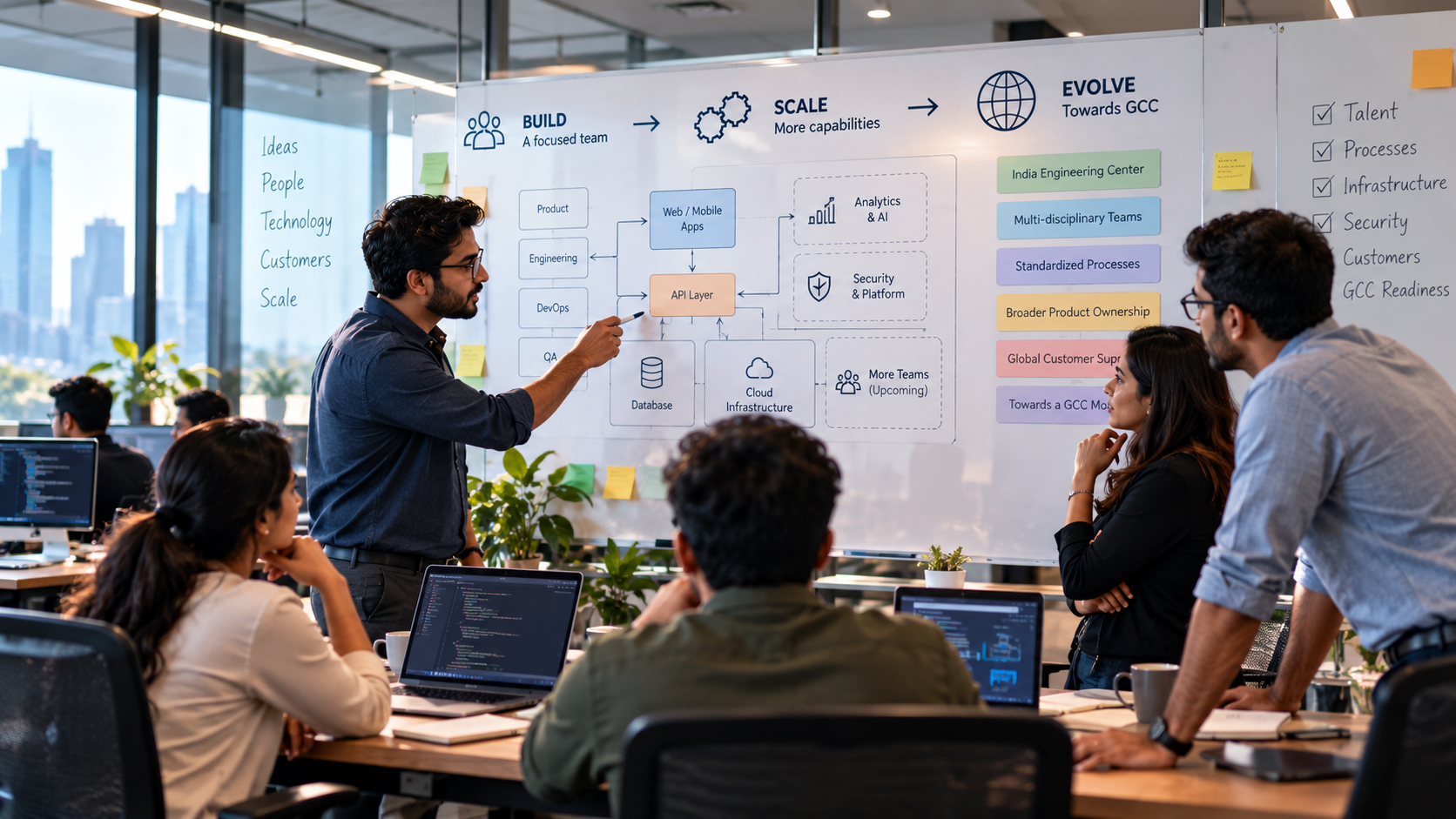
Is the company still sourcing delivery capacity?
Or is it now building an enduring organizational capability?
That is the point at which an offshore engineering decision can become a GCC question.
The distinction matters because a Global Capability Center is not simply a larger offshore team under a different label. It represents a different relationship between the organization, its technology capability, its people and the geography in which that capability is being built.
Capacity and capability are different operating goals.
A capacity model primarily answers a resourcing question.
How can we add skilled people quickly and economically to deliver defined work?
A capability model asks something broader.
What technology capability should the organization own, develop and retain over time?
The first model can work extremely well for clearly bounded delivery.
The second becomes more relevant when the offshore organization begins owning areas such as:
- product engineering;
- platform ownership;
- architecture;
- cloud operations;
- data and AI engineering;
- cybersecurity;
- quality engineering;
- customer-critical systems; or
- long-term technology transformation.
At that point, continuity, leadership depth, institutional knowledge and operating autonomy become more important than simply adding headcount.
The question changes when work becomes difficult to separate from the business.
Some work can be specified, delivered and handed back cleanly.
Other work becomes valuable precisely because the team develops context over time.
Engineers begin understanding the product deeply.
They learn why architectural decisions were made.
They build relationships with business stakeholders.
They know where technical debt exists, how customers use the system and which operational risks matter most.
That knowledge is difficult to describe fully in a statement of work.
It becomes organizational capital.
When offshore teams accumulate this kind of context, the strategic question becomes whether the organization wants that capability to remain external, partially external or increasingly institutionalized inside its own operating structure.
Scale alone does not make a GCC.
A large offshore workforce can still operate primarily as an execution layer.
Equally, a relatively modest center can own strategically important technology capability.
Headcount therefore tells only part of the story.
More useful indicators include:
- who owns technology decisions;
- where engineering leadership sits;
- whether the offshore organization owns outcomes or only tasks;
- how directly teams interact with product and business stakeholders;
- whether critical knowledge is retained inside the organization;
- how much autonomy teams have over delivery and operations; and
- whether the location is becoming part of the long-term technology strategy.
A GCC is therefore better understood as an operating-model decision than a staffing threshold.
Ownership is usually the strongest signal.
The clearest shift often occurs when offshore teams stop receiving work packages and start owning enduring technology outcomes.
There is an important difference between:
- developing features and owning a product area;
- supporting infrastructure and owning a cloud platform;
- executing tests and owning quality engineering;
- implementing data pipelines and owning a data capability;
- providing engineering capacity and owning part of the technology roadmap.
Outcome ownership requires different organizational conditions.
Teams need access to context.
They need decision rights.
They need leadership capable of balancing technology, customer and business priorities.
And they need accountability that survives beyond an individual project.
This is where GCC & Captive Center Enablement becomes fundamentally different from simply extending an offshore delivery team.
Leadership density matters before organizational scale does.
One of the most common scaling problems in distributed engineering is adding delivery capacity faster than leadership capacity.
The organization may successfully hire engineers but still depend on leaders in another geography for:
- architecture decisions;
- prioritization;
- customer escalation;
- technical direction;
- people development;
- cross-functional coordination; and
- operational accountability.
That creates a ceiling.
The team can become larger without becoming substantially more autonomous.
A mature GCC requires leadership density appropriate to the capability it owns.
That does not mean replicating every corporate layer locally.
It means ensuring that important decisions do not require constant escalation across geography simply because leadership was never deliberately built where the work now resides.
The talent proposition changes when the organization is building permanence.
Hiring for project capacity and hiring for long-term capability are not identical problems.
When an organization intends to build enduring technology ownership, it needs people who can grow with that ownership.
The talent model may need to support:
- technical career paths;
- engineering leadership development;
- architecture capability;
- product and domain knowledge;
- internal mobility;
- succession planning;
- specialist communities; and
- long-term capability development.
The employment proposition changes as well.
Strong candidates increasingly want to understand not only the technology stack, but also what they will own, how decisions are made and whether meaningful careers can be built locally.
A GCC strategy that focuses heavily on hiring numbers and lightly on career architecture can create scale without creating institutional strength.
Knowledge retention becomes a strategic consideration.
Long-running technology systems accumulate knowledge that is difficult to replace quickly.
Why was a particular architecture chosen?
Which customer behaviours matter?
Where do operational risks tend to appear?
Which integrations are fragile?
Which technical compromises are deliberate?
When work is highly contextual, repeated knowledge transfer becomes expensive.
Organizations may therefore choose to internalize certain capabilities not simply because internal delivery is cheaper, but because retaining knowledge, decision-making and continuity has strategic value.
This is particularly relevant for platforms and systems that sit close to differentiated business capability.
A GCC does not have to mean abandoning partners.
The choice is often presented too simplistically.
Outsourced delivery on one side.
Fully captive GCC on the other.
In practice, many effective technology organizations use a portfolio of models.
A GCC may own product, architecture and strategic engineering while partners provide specialist capability or elastic capacity.
A partner may help establish the center and gradually transfer capability.
Managed services may remain appropriate for standardized operational areas while differentiated engineering stays internal.
The operating-model question is therefore not:
Should everything be captive?
It is:
Which capabilities should the organization own, and which should it deliberately source?
That is a much more useful strategic distinction.
Economics matter, but the business case should not stop at labor arbitrage.
Cost is a legitimate part of location strategy.
Ignoring it would be unrealistic.
But a GCC built primarily around salary differential can become strategically shallow.
The broader business case may include:
- access to deep technology talent;
- greater continuity;
- reduced dependency on individual suppliers;
- institutional knowledge retention;
- closer alignment between engineering and enterprise strategy;
- development of proprietary capability;
- follow-the-sun operations;
- leadership capacity in another major talent market; and
- greater flexibility in how future technology work is organized.
The relevant economic question is therefore total capability value, not simply cost per engineer.
Location strategy should follow capability strategy.
A common sequence is to choose a city first and define the capability later.
That reverses the logic.
The organization should first understand what it wants the center to become.
Does it need cloud engineers?
Product engineering leadership?
Cybersecurity specialists?
Data and AI capability?
Deep domain expertise?
Customer-facing engineering?
The answer influences the relevant talent pools, competition, leadership availability, compensation environment and long-term scalability of a location.
Location is therefore part of the capability architecture, not merely a real-estate decision.
Governance should create alignment without recreating headquarters remotely.
As an offshore organization grows, governance naturally becomes more formal.
The danger is creating a model in which every meaningful decision still flows back to headquarters.
The center then has accountability without authority.
A stronger model distinguishes between:
- enterprise decisions that should remain global;
- capability decisions that can be owned locally;
- shared standards that require consistency; and
- execution decisions best made close to the work.
The goal is not independence from the enterprise.
It is integration with enough decision authority to operate effectively.
The transition itself needs architecture.
Organizations rarely move cleanly from one operating model to another overnight.
For a period, several models may coexist.
Partner teams continue delivering.
New internal teams are hired.
Leadership responsibilities shift.
Knowledge is transferred.
Systems and customer relationships move gradually.
Without deliberate transition design, this period can create duplicated roles, unclear accountability and unnecessary tension.
A useful transition plan clarifies:
- which capabilities move first;
- which remain externally supported;
- how leadership is established;
- how knowledge transfer is measured;
- when ownership formally changes;
- how existing partners participate; and
- which outcomes indicate that the new model is working.
Operating-model transformation requires the same discipline as technology transformation: sequencing matters.
A practical test: when has an offshore model become a GCC question?
There is no universal threshold.
But several signals suggest the organization should evaluate the question explicitly.
01 — Critical knowledge is concentrating offshore.
The team increasingly understands systems, products or customers that are strategically important to the enterprise.
02 — Teams are beginning to own outcomes rather than tasks.
The work increasingly requires enduring ownership, not project delivery alone.
03 — Leadership dependency is becoming a constraint.
Local teams cannot scale further without stronger engineering, product or operational leadership.
04 — Talent continuity matters strategically.
The organization increasingly values retention, succession and capability development rather than interchangeable capacity.
05 — The location is becoming part of long-term technology strategy.
Investment decisions now assume that important capability will continue to be built there.
06 — Supplier boundaries are limiting integration.
The organization needs tighter connection between engineering, product, architecture and business decisions than the existing model naturally provides.
07 — The business case increasingly depends on capability, not just cost.
The value now comes from what the organization can build, retain and own in that geography.
The real question is what the organization wants to own.
Offshore engineering and GCCs are not opposing ideas.
They sit on a broader spectrum of technology operating models.
At one end, organizations purchase clearly bounded capacity or outcomes.
At the other, they build enduring internal capability with its own leadership, talent system, institutional knowledge and accountability.
Many companies will use both.
The important thing is to choose deliberately.
A delivery model should not drift into a GCC simply because headcount has grown.
And a GCC should not be created merely because the term has become fashionable.
The decision becomes strategically meaningful when the company concludes that a capability is important enough to own, develop and institutionalize over time.
That is when an offshore engineering question becomes an organizational design question — and ultimately a GCC question.