Building Real-Time Intelligent Personalization Across Retail Channels
USMICRO established an ODC-led personalization engineering model that unified first-party customer data, introduced predictive decisioning and connected digital and store interactions — creating a foundation for real-time, context-aware retail experiences.
What needed to change.
The retailer had reached the limits of traditional customer segmentation and static recommendation approaches.
Customer expectations were increasingly shaped by experiences that responded to intent, context and recent behavior in real time, while the retailer’s existing technology environment remained fragmented across e-commerce, mobile applications, customer-service systems and physical stores.
Transaction history, browsing behavior, service interactions and in-store activity were distributed across separate platforms, making it difficult to maintain a current and coherent understanding of the customer.
This fragmentation also limited the effectiveness of personalization models. Recommendations could be generated within an individual channel, but they did not consistently reflect what the customer had recently viewed, purchased, discussed with service teams or experienced elsewhere in the journey.
The retailer also needed to balance increasingly sophisticated use of first-party data with privacy, consent and governance requirements.
The challenge was therefore not simply to improve recommendation algorithms. It was to create a data and decisioning architecture capable of supporting intelligent personalization consistently across channels while remaining governable and operationally sustainable.
How the problem was approached.
USMICRO established a dedicated Offshore Development Center combining retail-domain engineers, data specialists, machine-learning practitioners and integration capability.
The engineering programme began with the customer-data foundation. First-party information from transactions, digital behavior, service interactions and relevant store activity was consolidated into a governed customer-data environment.
Identity and profile relationships were structured so that personalization decisions could operate against a more coherent customer context rather than isolated channel histories.
USMICRO then introduced machine-learning and decisioning services capable of evaluating purchase intent, product affinity and contextual signals in near real time.
Rather than treating personalization as a single recommendation engine, the architecture was designed as a reusable decision layer that could support e-commerce, mobile and emerging store experiences.
Additional experience technologies — including natural-language, visual and spatial interfaces where appropriate — could consume the same customer and decisioning foundations rather than creating isolated intelligence stacks.
The ODC model provided continuing capacity for model tuning, integration changes, data governance and experience optimization as customer behavior and retail priorities evolved.
What changed in the technology environment.
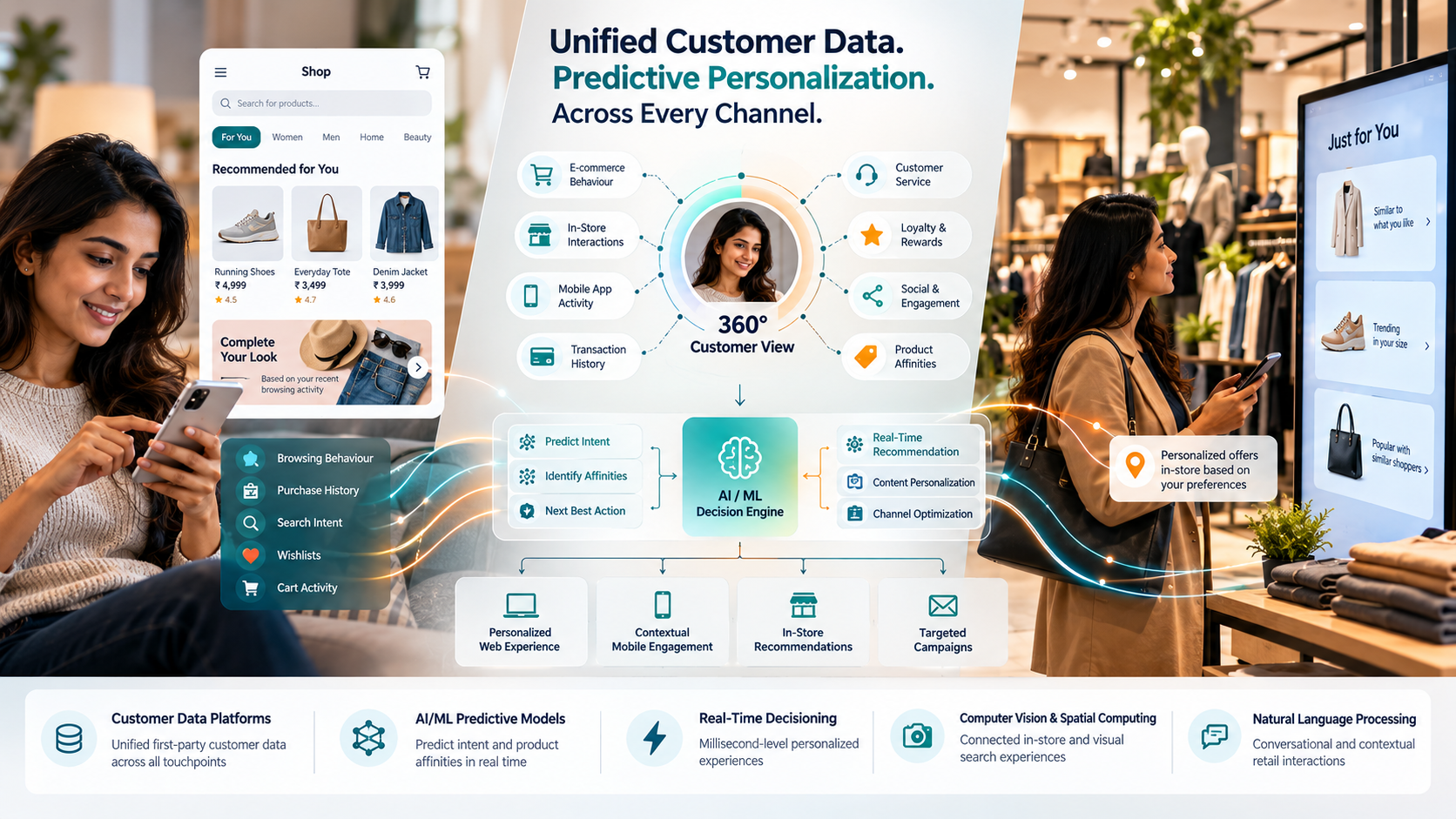
USMICRO introduced a connected personalization architecture spanning customer data, predictive models, decisioning services and omnichannel experience layers.
First-party data from transaction history, browsing behavior, service interactions and relevant in-store signals was consolidated through a Customer Data Platform to establish a more persistent customer profile.
Machine-learning models evaluated signals such as purchase intent and product affinity, while real-time decisioning services selected appropriate content, recommendations or actions for the current customer context.
APIs and integration services made those decisions available to e-commerce applications, mobile experiences and connected-store interfaces.
Where required by the experience, additional capabilities such as natural-language processing, visual search, computer vision and spatial interfaces could operate against the same governed customer-data and decisioning foundation.
Data-governance controls were incorporated into the architecture so that personalization logic could respect customer permissions, data classifications and appropriate usage boundaries.
The architectural shift was therefore from channel-specific segmentation and disconnected recommendation engines toward a shared customer-data foundation, predictive models and real-time decisioning services supporting connected retail experiences.
What can be credibly demonstrated.
The new personalization foundation gave the retailer a more consistent way to understand and respond to customers across digital and physical interactions.
Consolidating first-party data reduced the dependence on isolated channel profiles and enabled personalization decisions to use a broader customer context.
Real-time decisioning allowed experiences to adapt more quickly to customer intent rather than relying exclusively on static segments or preconfigured recommendation rules.
The shared architecture also made it possible for new retail experiences — including mobile, visual, conversational and connected-store interactions — to reuse common data and intelligence services rather than building independent personalization logic.
This reduced duplication across channels and created a more scalable foundation for continuously improving recommendation and engagement strategies.
The ODC model provided sustained data, engineering and optimization capacity so the personalization environment could evolve as models, customer behavior and retail priorities changed.
Most importantly, intelligent personalization became a reusable enterprise capability rather than a collection of disconnected channel features.